
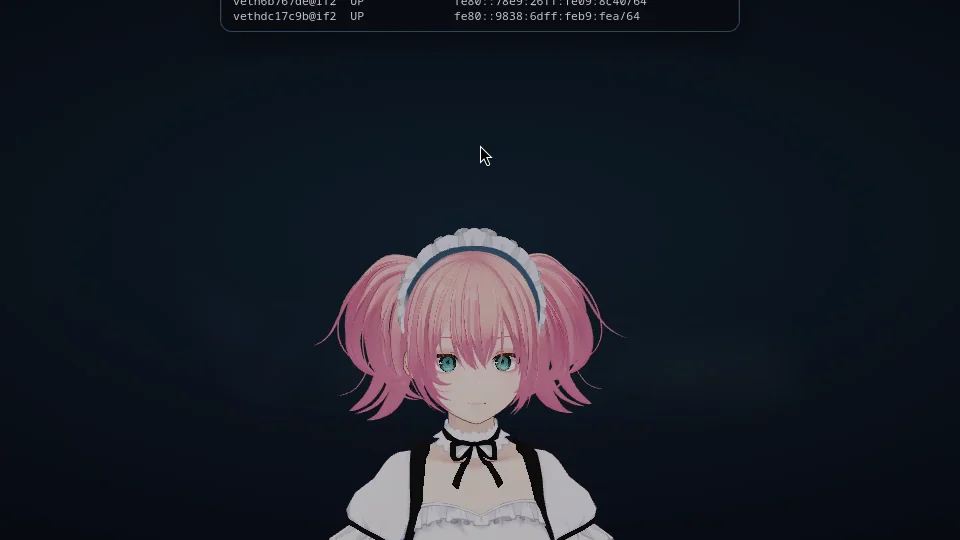
yousmall and centered
hannahSmall and centered, how can I assist you now?
youtop right corner
hannahTop right corner, here I am.
The window goes where you say, and "go to the other screen" jumps monitors.
Hannah, by Vanth Labs
Hannah talks back in real time, moves while she speaks, and does things on your computer (sorts your downloads, runs a command, finds a file), asking before anything risky. On your own GPU, or any API you pick.
She answers while the model is still writing, gestures with what she says, and stops the instant you talk over her.
0.72 s to the first word · < 0.1 s to yield
She acts on your machine: a real terminal, multi-step jobs, permission before anything risky, an audit log, undo.
Every command echoed in the terminal panel
Runs on your GPU, or on any API you choose. Open source. Swap the brain, the voice or the look from a panel.
Fully local on 16 GB · 0 VRAM with a cloud brain
What you can say
Four things she does today, cut from two recording sessions. Nothing staged, nothing generated: her window, on a real desktop.
yousmall and centered
hannahSmall and centered, how can I assist you now?
youtop right corner
hannahTop right corner, here I am.
The window goes where you say, and "go to the other screen" jumps monitors.
youopen GitHub
hannahHere's GitHub, you're on the homepage, ready to explore.
Apps and the browser: one fixed command, opened for real, and she stays on top.
youtell me a joke
hannahWhy was the math book sad? Because it had too many problems.
Every gesture is generated from the sentence she is saying, and lip-sync follows each syllable.
youhow much disk do I have left?
hannahYou have 8.83 terabytes of disk space available, which is 25% of your total storage.
A local skill: one fixed command, the real number back.
One voice. The agent never speaks: she narrates what it does, and she cannot claim something is done unless it is.
Hands · one job, start to finish
A folder of twelve mixed files, the request "organize them by type", and what happened next. Cut from one take; the timestamps are hers.
01
youuse your hands, organize the files in my demo folder by type
hannahI will use my hands to organize the files in your demo folder by type.
A job with several steps goes to the agent. The bar at the top of her window shows it running.
02
hannahMay I proceed to run ls ~/demo and organize the files by type?
hannahPlease press the button in the HUD to confirm.
Risk-tiered. A low-risk step goes on your "yes"; anything that moves or deletes needs the button in the HUD, not just your voice.
03
hannahI finished organizing the files in the demo folder. I created directories for images, documents and archives and moved the files into their folders.
Eight folders by extension. Every command it ran is echoed in the terminal panel, with undo.
Hands
Turn on tools and she opens apps, runs commands in a real terminal and searches the web. Give her a job with several steps, like "organize my downloads by type", and a separate agent does it, with risk-tiered approvals, an audit log and undo. Anything destructive asks you first; anything high-risk needs the button, not just your voice.

Presence
Every sentence becomes body language, generated by a text-to-motion model trained in-house rather than picked from canned clips, and lands on her skeleton through a mapping computed from geometry. Eight facial expressions, lip-sync per syllable, a gaze that follows your cursor. She starts answering while the model is still writing, one sentence at a time, and yields the instant you talk over her.
Measured on a text turn, local stack, RTX 5070 Ti. The first sentence waits for its own audio to synthesize; the rest stream behind it.

Lives on the desktop
On every workspace, above everything, and it remembers where you left it. Say "go to the other screen" and she moves. Close it and the whole stack shuts down and frees your GPU. Her look is any VRM avatar file: drop one in and she is someone else.

Works the same on
Under Wayland the window runs through XWayland so it can stay on top; native Wayland forbids it by design. hannah doctor tells you what your desktop supports.
Your data stays yours
127.0.0.1.Requirements
Linux, macOS and Windows. Fully local wants an NVIDIA card with 16 GB; with a cloud brain and the voice on the CPU it runs on far less. English voice out of the box; swap the voice or the language from the panel.
| Everything local | Light | |
|---|---|---|
| Brain | Ollama, qwen2.5:7b · 4.8 GB VRAM | Any API: Groq, OpenAI, Anthropic, Google, OpenRouter · 0 VRAM |
| Voice | Kokoro on the GPU · 0.9 GB | Kokoro on the CPU (slower), or ElevenLabs |
| Listening | Whisper, local · 0.8 GB | Cloud transcription |
| Vision | moondream, loaded only while the camera is on · 2.4 GB | Off |
| Body language | Our motion model · 1.2 GB | Same, on the CPU (slower to prepare each sentence, but she still moves) |
| Needs | NVIDIA, 16 GB for all of it at once | Any machine; an NVIDIA card makes the gestures instant, the CPU makes them a little late; what you send to a provider leaves the machine |
VRAM, everything local, measured
14.1 GB of 16 GB with every model resident, on an RTX 5070 Ti. Skip vision and use a cloud brain: < 3 GB.
Built on Ollama, Qwen 2.5, Whisper, Kokoro, moondream, VRM/VRoid, SMPL-X, Electron and three.js. Node 20+, Python 3.12+.
Providers
Three decisions in the panel (the brain, the voice, the hands) and everything technical folded under Advanced. Point her at any OpenAI-compatible endpoint, listen to a voice before you pick it, paste a key once. No restart, and keys never come back to the browser.
Teach her new skills with a markdown file: a description, one action, and the phrases that trigger it. Her look is a VRM model; her voice is any Kokoro or ElevenLabs voice.

Install
The installer sets up Hannah in your user folder, no admin: the voice, the listening, the overlay, the hands, and a hannah command to bring it all up. It does not install Ollama or a language model: the first time she opens, she asks where she should think.
curl -fsSL https://hannah.vanthlabs.org/install.sh | bash
curl -fsSL https://hannah.vanthlabs.org/install-mac.sh | bash
irm https://hannah.vanthlabs.org/install.ps1 | iex
x86_64 · everything on your NVIDIA card if there is one, else on the CPU · the brain, local or cloud, is her first question.
Apple Silicon or Intel · needs git (Xcode Command Line Tools) · gestures on Apple's GPU, voice on the CPU · the overlay app goes to ~/Applications, unsigned but de-quarantined for you.
Windows 10/11 x64, in PowerShell · gestures on your NVIDIA card if there is one, else on the CPU · the overlay installs per-user; SmartScreen may ask "More info → Run anyway" once.
hannah: she appears in the corner of your screen and asks where to think: on this PC (she installs Ollama in your user folder and downloads the model, if you say so) or a provider key (Groq, OpenAI, Anthropic, Google Gemini, OpenRouter).hannah doctor checks your desktop · hannah stop frees the GPU · hannah hands on adds the agent · hannah uninstall removes it allgit clone https://github.com/Vanth-Labs/hannah.git Hannah-Motion
cd Hannah-Motion
cat SETUP.mdFrom Vanth Labs
Hannah started from a small frustration: talking to a text box never felt like talking to anyone. The models got good; the interaction stayed a chat. We wanted the thing science fiction promised: something on your screen that listens, answers in a voice, moves while it talks, and can actually do what you ask on your computer, with your permission.
Most of the stack is open work we assembled: Ollama, Whisper, Kokoro, VRM avatars. The part that was missing, we built: a text-to-motion model so that every sentence gets body language instead of a looping idle animation, and an agent under her voice that never speaks for itself.
Vanth Labs is two people, and honest about what Hannah needs. If you try her, tell us what broke. If you like her, a star helps more than you'd think.
Vanth Labs
FAQ
One command on Linux, macOS or Windows. Ten minutes and a coffee while the models download.
InstallFree · MIT · nothing leaves your machine by default